Prerolls
News
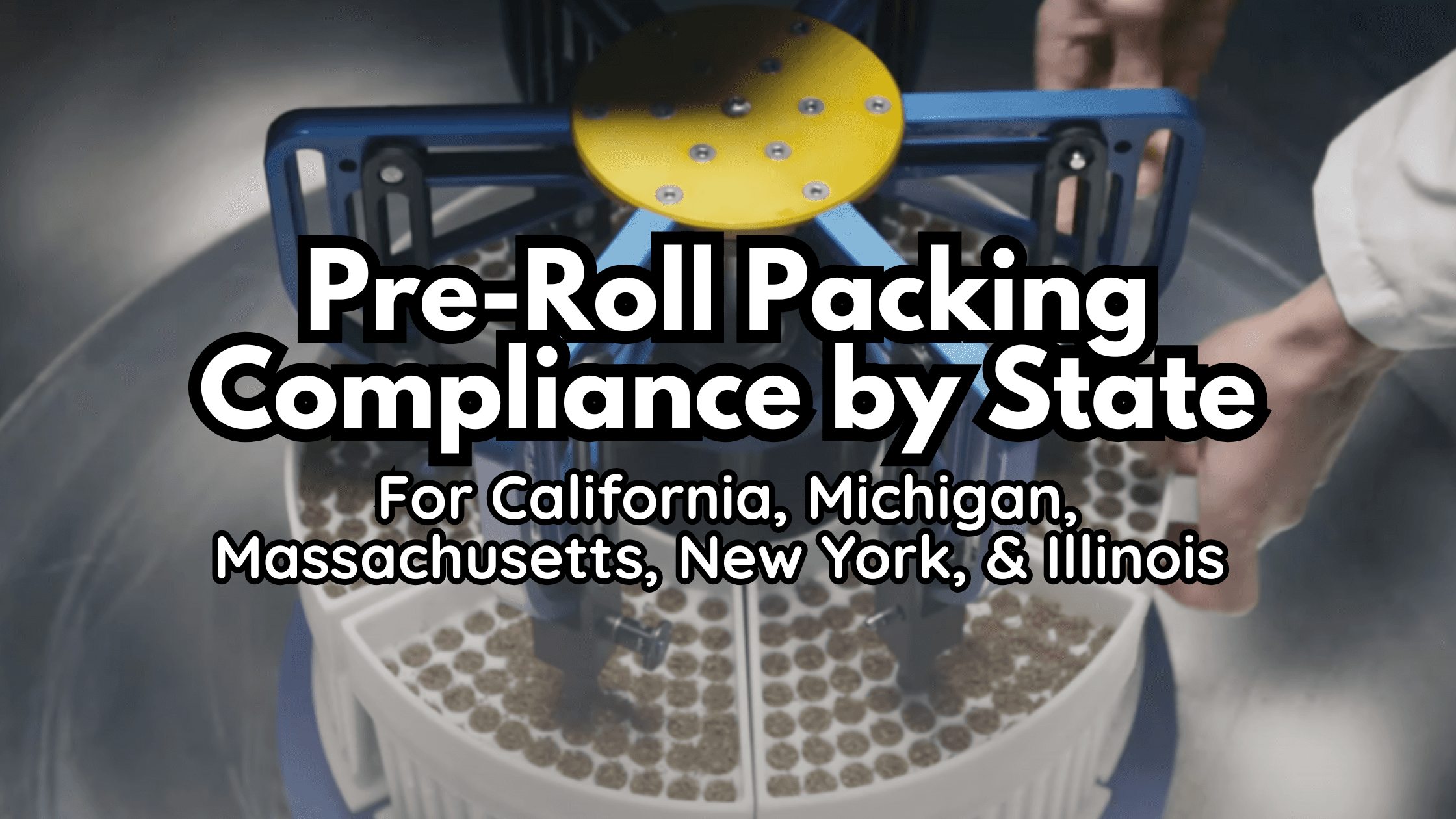
Pre-roll packaging compliance by state
Heads up: packaging and labeling regulations change regularly in every legal cannabis state. Use this guide as a working overview, then verify current requirements directly with your state's regulatory agency before going to print. We will update this article as major changes occur.
Packaging compliance is one of those things that brands tend to underestimate until they get burned. A shipment held up at a distributor, a product pulled from shelves, or a fine from a state inspector over a label violation can set a company back months. And the frustrating part is that most of these issues are avoidable.
The problem is that there is no national standard for cannabis packaging. Every state runs its own program, sets its own rules, and updates them on its own schedule. What passes inspection in Michigan might not clear the bar in California. A label that works in Colorado needs additions before it ships to Massachusetts. If you are selling pre-rolls in multiple states, or planning to, you need a working understanding of what each market requires.
This guide covers the states where pre-roll volume is highest: California, Colorado, Michigan, and Massachusetts. It also touches on New York, which is still building out its market but already has detailed rules in place. At the end, there are some practical notes on how multi-state operators generally manage the complexity.
The baseline requirements every state shares
Before getting into the state-by-state details, it helps to know what nearly every legal cannabis market has in common. These are the baseline requirements you will encounter everywhere:
Child-resistant packaging. Every state requires it. The standard comes from the Consumer Product Safety Commission's Poison Prevention Packaging Act (16 CFR 1700). Packaging must be designed so that a child under five cannot open it within a reasonable amount of time, while still being accessible to adults. For pre-roll multi-packs, this typically means a certified push-and-turn mechanism, a certified zipper pouch, or a similar tested format.
Tamper-evident seals. Consumers need to be able to tell if a package has been opened before they buy it. This can be a breakable seal, a shrink band, a tear-away tab, or any other mechanism that shows obvious evidence of tampering.
No appeal to minors. Every state prohibits packaging that uses cartoon characters, candy-like imagery, bright colors used in a way that targets children, or any design element that makes a cannabis product look like something intended for kids. This applies to pre-rolls and any multi-pack format.
No misleading health claims. You cannot claim your pre-rolls cure, treat, or prevent any medical condition unless you are operating under a medical program with specific approved claims.
THC/CBD potency disclosure. Required everywhere, though the specific format varies by state.
A state-specific universal symbol. Most states have their own version of a cannabis identifier that must appear on packaging.
With those as the foundation, here is how the major markets add their own requirements on top.
California
California's Department of Cannabis Control (DCC) runs one of the more detailed packaging programs in the country. The rules apply to all pre-rolls and pre-roll multi-packs sold in the state.
Packaging structure
All cannabis products, including pre-rolls, must be in child-resistant, tamper-evident packaging before leaving a licensed facility. Multi-packs and any product that involves multiple uses must also be resealable. The package cannot be transparent in a way that makes the product visible from the outside.
California also introduced updated sustainability requirements in 2024. If you use the recycling symbol or any recyclable claim on your packaging, that claim must be accurate and verifiable under Senate Bill 343. Packaging that uses inks, adhesives, or labels that prevent recyclability cannot carry a recycling claim.
Label requirements for pre-rolls
California requires two panels on every package: a primary panel and an information panel. Here is what each needs.
The primary panel must include: the product identity (e.g., "Cannabis Pre-roll"), net weight in both metric and U.S. customary units, the California universal cannabis symbol (at least 0.5 inches by 0.5 inches, in black or white), and the DCC-required government warning statement in bold.
The government warning reads: "GOVERNMENT WARNING: THIS PACKAGE CONTAINS CANNABIS, A SCHEDULE I CONTROLLED SUBSTANCE. KEEP OUT OF REACH OF CHILDREN AND ANIMALS. CANNABIS MAY ONLY BE POSSESSED OR CONSUMED BY PERSONS 21 YEARS OF AGE OR OLDER UNLESS THE PERSON IS A QUALIFIED PATIENT. CANNABIS USE WHILE PREGNANT OR BREASTFEEDING MAY BE HARMFUL. CONSUMPTION OF CANNABIS IMPAIRS YOUR ABILITY TO DRIVE AND OPERATE MACHINERY. PLEASE USE EXTREME CAUTION."
The information panel must include: the licensee name and license number, the UID (unique identifier) number from California's track-and-trace system, the date of manufacture or packaging, cannabinoid content by percentage (THC, CBD, and any other cannabinoid present above 5%), the name of the testing laboratory, and batch or lot number.
California also requires a Proposition 65 warning for products containing cannabis smoke or delta-9 THC. The language for this was updated in 2022 and must follow the current OEHHA-approved format.
What makes California different
The state mandates specific formatting for label text, including minimum font sizes and contrast requirements. Warning statements must appear in a bordered box of specific dimensions. California also requires a QR code on labels that links to the product's lab testing results. For infused pre-rolls, ingredients must be listed in descending order by weight.
One more thing worth knowing: California limits the ingredients that can go into inhalable cannabis products. Per Section 17303.1, inhalable products are limited to cannabis, cannabis concentrate, botanically-derived terpenes, rolling paper, leaf, pre-roll filter tips, and FDA-approved inactive ingredients. If you are making infused pre-rolls, the infusion material needs to fit within these categories.
If you are planning to expand from Colorado into other states, the MED's requirements are a reasonable starting framework. Several newer markets built their rules with Colorado's program as a reference.
Michigan
Michigan has the highest pre-roll unit volume of any state in the country, and its packaging rules are generally considered more operator-friendly than California's or New York's. That said, the Cannabis Regulatory Agency (CRA) enforces what is on the books, and the labeling requirements are detailed.
Packaging structure
Michigan requires child-resistant packaging for cannabis products generally. However, one thing that stands out: the state has historically not required child-resistant packaging specifically for pre-roll products as a standalone format. This is worth verifying with the CRA directly, as rules do get updated, but it has been a point of difference between Michigan and most other major markets.
All products still need tamper-evident packaging and cannot use designs that appeal to minors. No cartoon characters, no imagery that mimics food or drink products marketed to children, and nothing in the shape of a human, animal, or fruit (this is explicitly listed in the rules).
Label requirements for pre-rolls
Michigan's labeling rules under Rule 420.504 of the Michigan Administrative Code require the following on every pre-roll package: product name, licensee name and license number, batch or lot number, THC and CBD content in both milligrams and percentage, net weight in both U.S. customary and metric units, the name of the testing lab and date of testing, the Michigan universal cannabis symbol, and all required health warnings.
For pre-rolls specifically, activation time must also be indicated. This can be done with a symbol or text, and it lets consumers know roughly how long before they should expect to feel effects.
Health warnings must include statements about health risks, driving impairment, keeping the product away from children, and risks related to pregnancy. Michigan uses Metrc for seed-to-sale tracking, so your UID or batch number needs to correspond to your Metrc records.
What makes Michigan different
Michigan is one of the more affordable and accessible markets from a packaging standpoint, partly because the child-resistant requirement for pre-rolls specifically has been less stringent than other states. The state also allows a wider range of packaging formats than some markets, which gives brands more options for differentiation on the shelf.
That said, Michigan's market is extremely competitive on price. With an average pre-roll item price around $5.57, the lowest in the country, packaging costs are scrutinized more closely here than in markets where average prices are two or three times higher.
Michigan is a volume game. If you are manufacturing there, operational efficiency and tight per-unit cost management matter more than in almost any other market. Packaging choices that add cost without adding shelf appeal will hurt you.
Massachusetts
Massachusetts has some of the highest pre-roll market share of any tracked state, with nearly one in five cannabis dollars going to pre-rolls. The Cannabis Control Commission (CCC) oversees packaging and labeling, and the requirements lean toward the detailed end of the spectrum.
Packaging and label requirements
Massachusetts requires child-resistant, tamper-evident packaging for all cannabis products. Labels must include: the product name, the cultivator or manufacturer name and contact information, lab test results and batch number, the state-issued cannabis identifier symbol, required health warnings, and a seal certifying the product meets testing standards.
Font size minimums apply. All required label text must be no smaller than 1/16 inch. Warning statements must be prominent and clearly readable.
Massachusetts prohibits packaging that resembles food or drink products, uses cartoon characters, or includes imagery likely to appeal to people under 21.
New York
New York's cannabis market is still building out its retail infrastructure, but the Office of Cannabis Management (OCM) has put detailed packaging rules in place from the start. The rules were significantly updated in December 2025 under amendments to Part 128 and Part 129 of Title 9 NYCRR, with most provisions effective immediately and some packaging changes on a six-month delay.
Packaging structure
New York requires child-resistant, tamper-evident, resealable, and opaque packaging. The state has strict plain packaging rules: packaging cannot use bright colors, decorative imagery, or designs that might appeal to minors. This creates real constraints on branding, since the OCM's interpretation of "appeal to minors" has been applied broadly.
Label requirements
New York labels must include: the product name, license number, batch number, net weight, THC and CBD content, the state cannabis symbol, required health warnings, and lab testing information. The state allows social equity licensees to identify that status on their packaging, which is a unique element not found in most other markets.
New York also has a multi-tiered tax structure that includes a potency-based THC tax on top of standard excise taxes. While this is a tax issue rather than a packaging issue, it affects how brands present potency information because the tax rate ties directly to THC content declared on the label.
What to watch in New York
The December 2025 PLMA rule updates introduced changes that some operators are still working through. If you are entering New York, read the current version of 9 NYCRR Part 128 directly, not a summary. The plain packaging rules in particular are interpreted more strictly here than in most other states, and what works in Michigan or Colorado may not pass review in New York.
Illinois
Illinois is worth a brief mention as one of the larger Midwest markets. The Division of Cannabis Regulation enforces packaging rules under the Cannabis Regulation and Tax Act (410 ILCS 705/55-21). Requirements include child-resistant and tamper-evident packaging, opaque packaging for certain product types, and a detailed label that includes product name, THC content, ingredients, net weight, health warnings (including a specific statement that "Smoking is hazardous to your health" for inhalable products), and the state cannabis symbol.
Illinois also requires that all cannabis-infused products be individually wrapped at the point of preparation, which affects how infused pre-rolls are handled in production and distribution.
Practical notes for multi-state operators
If you are selling pre-rolls in more than one state, you are essentially running parallel compliance programs. Here is what operators in that position generally do to keep it manageable.
Build a label template per state, not per product. Your product may be the same, but the label cannot be. Maintain a master label template for each state you operate in and update it when regulations change. Trying to create a universal label that works everywhere rarely works and often creates compliance gaps in every market.
Track regulatory updates by source. Subscribe to update notices directly from each state's regulatory agency, not just industry newsletters. The California DCC, Colorado MED, Michigan CRA, Massachusetts CCC, and New York OCM all publish rule changes. A change can affect your inventory before a newsletter picks it up.
Get label reviews before you print. This is especially true in California, New York, and Massachusetts. A compliance attorney or packaging specialist review before a large print run is significantly cheaper than reprinting or pulling product from shelves.
Document your packaging certifications. Child-resistant certifications, test lab results, and batch records should be stored in a way that makes them easy to produce during an inspection. Several states have moved toward requiring digital documentation tied to QR codes on packaging, and this trend is likely to continue.
Know the exit bag rules. Most states require opaque, child-resistant exit bags at the point of sale, even if the product packaging itself already meets CR standards. This is handled at the dispensary level, not your level, but if you are operating a vertically integrated business that includes retail, it is part of your compliance picture.
Packaging compliance is not a one-time project. Treat it as an ongoing operational function, the same way you treat lab testing or Metrc reporting. Regulations change, and the brands that catch changes early are the ones that avoid expensive corrections.
CannaTechSupply.com provides manufacturing systems for cannabis pre-roll and edibles producers. Explore our pre-roll manufacturing systems or contact our team to discuss your production goals.
Preroll Systems
Best Preroll Machine
Best Gummy Machine
Preroll Centrifuge
Best Preroll Centrifuge Machine
How to Make Prerolls
KungTech GPC
KungTech
Hummingbird
Hummingbird PR-1
Hummingbird Centrifuge
Preroll Pods
Preroller
Preroll-er
Hummingbird vs KungTech
Gravity Packing Centrifuge
Best Preroll Machine
Versatile Preroll Machine
Density Control Prerolls
Preroll Flip Test
Preroll Upside Down Test
Durable Preroll Machine
Scalable Preroll Machine
Preroll Packing Centrifuge
SaintyCo
Sorting Robotics